The Myth of the Perfectly Matched Plant Border
A perfectly matched plant border can look flat. Use contrasting leaf shapes, textures, and repeating accents to create a garden edge with depth.
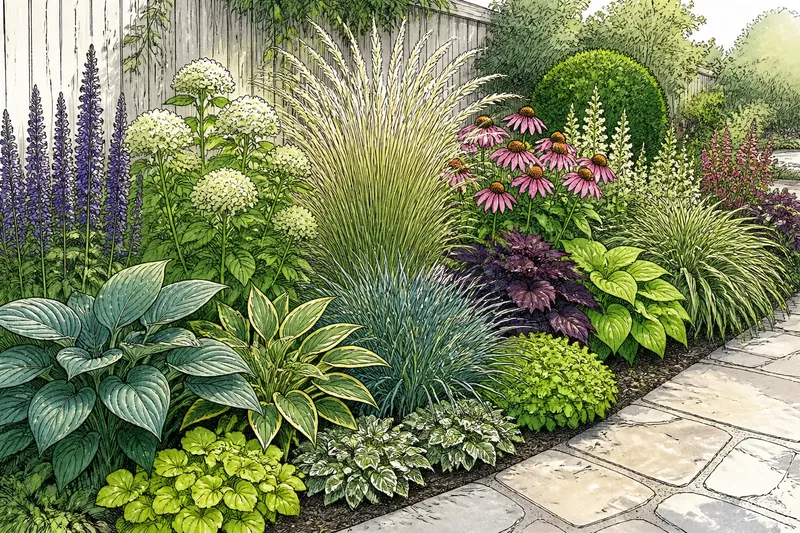
Why can a border that matches by color and height still look flat? A perfectly matched plant border often lacks the changes in shape and texture that help the eye move through a garden. Instead of coordinating every plant, give neighboring plants different jobs: one brings a broad leaf, another a fine spray, and a third a clear color accent.
Why can a perfectly matched plant border look flat?
When every plant has a similar outline, height, or color, the border reads as one continuous block. A row of rounded mounds may look tidy, but its edges blend together. Likewise, several plants with similar green foliage can merge even if their flowers differ slightly.
Uniformity is not the same as coherence. A border can feel connected because a few colors or forms recur, while still offering enough contrast to distinguish individual plants. Think of a favorite outfit: matching shoes and a bag can tie it together, but every piece does not need the same shape or fabric.
Which contrasts make a border more interesting?
Start with leaf shape and texture, since foliage stays visible beyond a brief flowering period. Contrast broad leaves with narrow blades, upright forms with arching ones, or soft-looking foliage with crisp, glossy leaves. The difference should be easy to see from the path or patio where you usually view the border.
- Shape: Place a spiky or upright plant near a rounded, mounding one.
- Texture: Set finely divided leaves beside larger, smoother foliage.
- Height: Layer low edging plants in front of taller, airy forms rather than making every plant equally tall.
- Color: Use a restrained accent, such as a repeated flower or foliage tone, against a quieter background.
- Density: Combine a plant with a solid outline and one with visible gaps or delicate stems.
These are design relationships, not a shopping formula. Choose plants suited to the border’s light, soil, and available space first; then look for contrasts among the options that will grow well there.
How do you combine contrast without making the border chaotic?
Use repetition to connect plants that differ in other ways. A color can recur in separate parts of the border, or a particular upright shape can appear at intervals. Repetition gives the eye something familiar to follow, while contrasting foliage keeps each grouping distinct.
Limit the number of strong contrasts competing in one small area. For instance, pair a bold leaf shape with a fine texture, then let a quieter plant bridge to the next group. If every plant brings a different color, outline, and texture, the border can feel busy rather than varied.
Say you have a narrow bed with a row of similar green mounds. Imagine replacing a few in the middle with an upright, fine-leaved plant and placing a low, broad-leaved plant nearby. The expected result is a more visible change in outline and texture, while the repeated green foliage still helps the bed feel connected.
How should plant height and color work together?
Height is useful for arranging a border, but it need not be identical across a row. A common approach is to put shorter plants toward the front and taller ones behind, especially where a wall or fence forms the backdrop. In a border viewed from more than one side, place taller forms nearer the center so they do not hide shorter plants.
Color can reinforce that arrangement without becoming the only organizing principle. A small repeated accent can guide the eye along the bed, while foliage contrasts provide interest between blooms. Check the border from its main viewing point: if flowers are doing all the work, consider whether leaf forms can carry the design when the flowers are absent.
What should you check before choosing plants?
Compare the mature growth habits on plant labels or reliable garden-center information, not just the size of the nursery pot. A plant that eventually spreads widely may crowd a delicate neighbor, and a tall plant may shade one placed in front. Leave room for the forms to develop so their contrasts remain visible rather than disappearing into a tangle.
Also consider care needs alongside appearance. Plants grouped together should have compatible preferences for light and moisture; otherwise, a pleasing arrangement may be difficult to maintain. Where care requirements vary, separate plants into suitable sections rather than forcing them into one tightly mixed cluster. Follow plant labels and local guidance when growing conditions or care instructions differ.
Can a matched color scheme still have contrast?
Can a border use mostly green foliage?
Yes. Green foliage can still vary in shape, size, sheen, and density. Those differences create a legible pattern even when the palette stays quiet.
Should every plant have a different texture?
No. A few contrasts are easier to read than a collection in which every plant competes for attention. Repeat some forms and let one or two neighbors provide the strongest difference.
What if I prefer a coordinated color palette?
Keep the palette coordinated and vary the foliage outlines or growth habits. A shared color scheme can unify the border without requiring plants to match in every other way.
How can you review the border before planting?
Lay nursery pots out in their intended positions, then step back and look from the garden’s usual viewing angle. Notice where adjacent plants disappear into one another and where the same height or rounded outline continues for too long. Shift a pot or two to create a clear contrast, and check that taller plants will not block the view of shorter ones.
A perfectly matched plant border is not the only route to a composed garden. Repeat a few colors or forms, then let differences in leaf shape, texture, and height create movement. When choosing plants for a border, consider whether each neighbor adds a visible contrast as well as fitting the growing conditions; that small decision can keep the planting distinct without sacrificing a sense of order.