Why a Plant Needs More Than a Sunny Window
Learn how to assess window direction, sunlight duration, and room conditions so you can choose a houseplant that suits the light you actually have.
Which plant will suit the light in your room? Before choosing a windowsill plant, notice where the window faces and how sunlight moves through the space over a day. “Sunny” can mean a bright room with no direct beam, or a narrow patch of sun that disappears before lunch; those are different places to grow.
Think of a window as a moving spotlight, not a fixed lamp. Its beam shifts with the sun, while the room’s brightness also changes with clouds, nearby buildings, and the distance from the glass. A short daylong noticing exercise gives you a more useful picture than a quick glance at noon.
Watch the window through the day
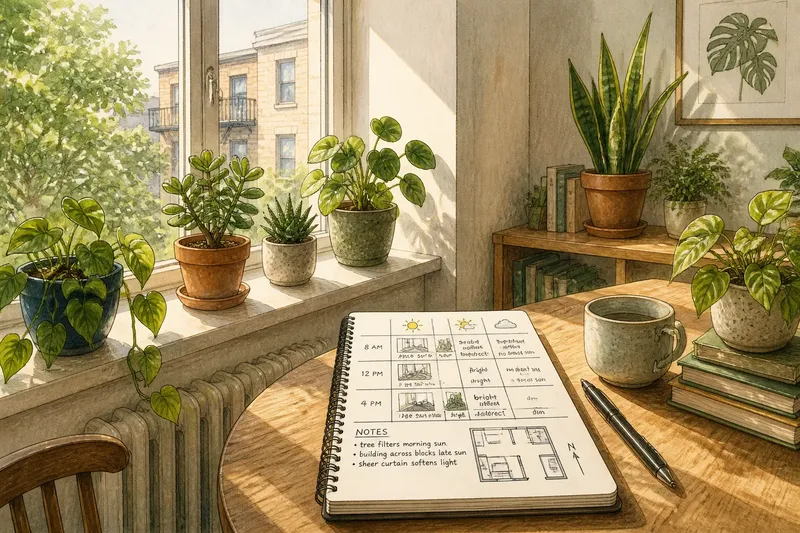
Choose an ordinary day when you can check the room a few times. You do not need a light meter or a complicated chart. Use a notebook or your phone’s notes app, and make a rough record of what the light looks like and where it lands.
- In the morning, note whether direct sunlight reaches the sill, the floor, or neither.
- Around midday, check whether the bright patch has moved, widened, or vanished.
- Later in the afternoon, look for another period of direct sun or a change in overall brightness.
- At each check, note whether the sky is clear, overcast, or changing.
- Record nearby obstructions, such as a balcony, tree canopy, wall, or building across the street.
“Direct sun” means a visible beam falls on the surface; a bright room without a beam is still indirect light. A sheet of white paper can help you compare spots: notice whether it looks clearly lit near the window and how much dimmer it appears farther into the room. This is a simple comparison, not a technical reading.
One day is a snapshot, not a permanent verdict. If the weather is unusually gloomy or the room is affected by seasonal shade, repeat the checks on another day. You are looking for a recurring pattern: when the sun arrives, how long it stays, and how far its light reaches.
Direction matters, but it does not decide everything
Window direction offers a useful clue about when sunlight may enter. In many homes in the Northern Hemisphere, south-facing windows tend to receive the strongest and longest direct sun, while north-facing windows usually provide steadier indirect light. East-facing windows often catch morning sun, and west-facing windows may receive stronger late-day light.
Those are tendencies, not promises. The view outside can change the result: a tree may filter a south-facing window, while a pale wall opposite a north-facing one may reflect brightness back into the room. Latitude, season, window size, curtains, and the building’s layout all matter. In the Southern Hemisphere, the broad pattern of sun-facing sides is reversed.
Use the direction as a starting point, then let your observations settle the question. If an east-facing sill gets a clear morning beam and stays bright afterward, that differs from an east-facing sill shaded by a neighboring building. The compass label alone cannot tell you how much light reaches the exact place where a pot would sit.
Separate brightness from direct sunlight
A room can feel bright to you because your eyes adjust quickly, even when a spot several feet from the window receives much less light. Conversely, a short direct beam can create a bright patch without making the entire room sunny. Keep these observations separate: note direct sun, general brightness, and distance from the glass as distinct details.
Check more than the sill. Look at the top of a nearby shelf, a table beside the window, and a lower corner that might seem appealing for a plant. A place just off the sill may receive bright indirect light, while a spot across the room could be noticeably dimmer. If you plan to use a sheer curtain, observe with it in its usual position; it changes the light that reaches the leaves.
Also look at what blocks or redirects light at different times. Open blinds, a deep overhang, and neighboring foliage can all alter the beam. Glossy surfaces may reflect light into a space, but do not assume a reflection is equivalent to direct sun. Your notes should describe what you can see, rather than assign the room a flattering label.
Turn your notes into a sensible plant choice
Once you know the pattern, compare it with the light guidance on the plant label or from a reliable nursery. Descriptions such as “bright indirect light” and “direct sun” refer to different conditions. If your notes show a brief morning beam followed by a bright room, look for a plant described as suitable for bright indirect light or gentle morning sun, rather than choosing solely by the window’s direction.
For a dimmer spot, do not treat a plant described as “low light” as a plant that needs no light. It still needs an appropriate place to grow, and the room’s darkest corner may be a poor fit. Consider moving a plant closer to the window, choosing a different location, or using a suitable grow light if you want to grow something where natural light is limited.
Say you notice that an east-facing kitchen sill gets a short morning beam, but the nearby dining table remains bright without direct sun for much of the day. If you want a plant on the table, you would compare its care label with that indirect-light pattern, not with the sunniest moment on the sill. The useful result is a better-matched location to try, with the plant’s response still something to observe over time.
Plant labels, manufacturer instructions for grow lights, and local guidance can differ, so follow the directions that apply to the particular plant or equipment. Avoid treating a general room description as a substitute for the needs stated for a specific plant.
What should I check before choosing a windowsill plant?
How do I tell direct sun from bright indirect light?
Direct sun makes a visible beam or sunlit patch land on a surface. Bright indirect light can still feel luminous, but the plant’s spot is not receiving that direct beam.
Does a south-facing window always get the most sun?
It often receives strong sun in the Northern Hemisphere, but nearby buildings, trees, overhangs, and the season can change the conditions. Observe the sill itself instead of relying on direction alone.
Is a plant near the window getting the same light as one on the sill?
No. Light can drop off as you move away from the glass, and furniture or curtains may add shade. Check each proposed location rather than assuming the whole room has one light level.
What if the room is cloudy during my observation day?
Record the sky conditions and repeat the exercise on a clearer day if you can. A cloudy-day note still tells you about the room’s general brightness, but it may not reveal when direct sun reaches the window.
Use the plant’s response as a later clue
After choosing a spot, keep observing rather than assuming the initial match will stay right. Notice whether the plant’s growth appears healthy and balanced, whether it leans strongly toward the window, and whether leaves show signs of stress. A single change does not identify the cause by itself; check watering, temperature, and other care conditions too.
Rotate the pot only if that suits the plant and its care guidance, and avoid moving it repeatedly from one extreme to another while trying to read its response. If a plant seems to struggle, compare its location with your light notes and consider a modest change, such as moving it nearer to the window. Give the new position time to show a pattern before making another adjustment.
For a useful plant-light match, write down three things: the window’s direction, the times and places where direct sun appears, and how bright the intended spot stays after the beam moves. Search for a plant suited to that description, not simply one advertised as a “sunny-window” plant. The extra observation turns a vague impression into a practical choice you can revisit as the room and season change.